

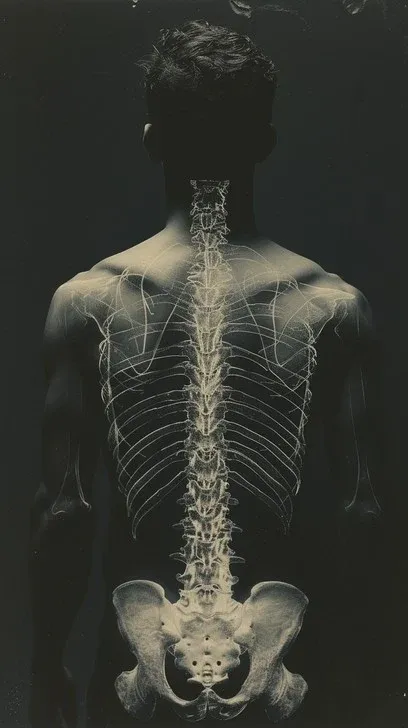
There is a pattern I encounter regularly, both in clinic and in conversation.
Someone has been to another practitioner, or perhaps had imaging done. An MRI, a scan, a report. They walk in and tell me, with conviction: I have a disc bulge. I have a meniscal tear. I have degenerative changes. Sometimes it is even more abstract — my C5 is out of place.
They say it the way you might state your name. It has become part of their identity. And often, it becomes the thing that governs what they believe they can and cannot do — regardless of what their body is still capable of.
But here is the problem. The diagnosis, in many cases, tells you remarkably little about what that person is actually experiencing. A scan is a structural reading taken at a single moment. It does not capture function. It does not capture capacity. It tells you what something looks like, not how it behaves.
I have seen people with significant findings on imaging who move well, train hard, and live relatively pain free. I have also seen people with unremarkable scans who are barely functional — guarded, restricted, afraid to move. If the diagnosis were the full picture, this would not be possible. But it happens constantly, because the body operates on a different level to the written report.
The body does not organise itself around a diagnosis. It responds to what it perceives, not to what a radiologist has described.
The Trap of Naming
The mind craves classification. To name something is to feel that you understand it. A diagnosis offers a sense of certainty in an uncertain situation: now I know what is wrong with me. And in some cases, that clarity is genuinely useful. Naming can direct treatment, guide decisions, and provide necessary context.
But naming can also become a cage.
When a person begins to identify with a diagnosis — when “I have a torn meniscus” becomes “I am someone with a bad knee” — something shifts. The label stops being clinical information and starts functioning as a belief system. It shapes what they attempt, what they avoid, and how they relate to their own body. The diagnosis begins to dictate behaviour more than the body itself does.
This is not limited to physical conditions.
In psychology, the same pattern plays out with striking regularity. A person receives a diagnosis — anxiety, depression, ADHD, PTSD — and gradually, sometimes without realising it, they begin to build their identity around it. I am anxious. I am depressed. That is just how I am. The diagnosis, intended as a clinical tool, becomes a fixed narrative. It explains everything. And because it explains everything, it closes the door on curiosity, adaptation, and change.
The lived experience — the actual texture of what is happening in the body and mind, and how that may change — gets buried beneath the label.
What I Learned From My Own Back
About a year ago, I experienced an acute lower back issue during training. It was significant — enough to stop me in my tracks and send me looking for answers.
I saw several practitioners. Assessments were done. Imaging was done. And yet no one could give me a clear explanation of what was actually happening. Not because they lacked skill, but because they were not inside my body. They could observe, test, and measure — but they could not feel what I was feeling.
What did help was not a definitive label. It was a process. Treatment was necessary — I needed skilled hands and clinical input. But alongside that, I needed to pay close attention to what was actually happening, not what I had been told should be happening. To move with attention to what the body would and would not tolerate. To respect limits without surrendering to them. To explore what was possible rather than fixate on what was wrong.
Gradually, the pain began to settle. Not because someone finally named the problem, but because I engaged with it directly — through attention, through careful movement, through a willingness to work with what was actually present rather than what a report said should be present.
I did not need a hard and fast label to wave around for the rest of my days. I needed to pay attention.

What the Body Actually Knows
The body does not deal in categories. It deals in sensation, tension, ease, restriction and response. These are not vague terms. They are immediate, specific, and far more informative than most people realise.
In clinical practice, much of the most effective work does not require fixation on a diagnosis. It requires attention to what is actually present. Where is the tension? How does the breath organise? What movements create ease, and which ones provoke guarding? How does the nervous system respond — not according to a textbook, but right now, in this person?
On the mat, this becomes even clearer. A martial artist does not think about anatomy mid-exchange. The body reads pressure, angle, timing, and intent — and responds before conscious thought intervenes. That response is not random. It is the product of thousands of hours of patterning and adaptation. It is intelligence that lives in tissue and in the nervous system. You cannot acquire it intellectually. You can only develop it through sustained, embodied practice.
The Limits of Abstraction
None of this is a case against medical investigation. There are times when imaging is essential, when a scan reveals something that demands attention, and when a surgical opinion is not only appropriate but necessary. Structural damage, progressive conditions, red flags that require ruling out — these are clinical realities, and ignoring them in the name of bodily intuition would be reckless, not wise.
The problem is not diagnosis itself. The problem arises when the abstraction replaces the experience — when people stop listening to what the body is actually telling them because they already have a name for it.
This is a subtle form of avoidance. If I can label my condition, I do not need to sit with the discomfort of not fully understanding it. I do not need to pay close attention to how it shifts, changes, or responds. The label handles the uncertainty for me. It becomes a way of managing the anxiety of not knowing by pretending that naming is the same as understanding.
But the body is not fooled by this. It continues to signal, adapt, guard, and restrict — regardless of what you call it.
Returning to the Source
The most effective practitioners I have encountered — in martial arts, in manual therapy, in psychology — share a common quality. They pay attention to what is actually happening, not to what should be happening according to a theory or a label.
But this is not only a question for practitioners. It is a question for anyone who has ever received a diagnosis and allowed it to become the final word — who stopped asking what is my body actually telling me? and settled instead for what have I been told is wrong with me?
To recognise the body as a form of intelligence is not to reject clinical reasoning. It is to refuse the assumption that naming something is the same as understanding it.
The diagnosis tells you what something is called.
The body tells you what is actually going on.
Author’s Note:
This piece comes from clinical practice and from years on the mat — two settings where the gap between what people believe about their body and what the body actually communicates becomes impossible to ignore.